Artists & programming
Review booking mix, routing, travel and hospitality before contracting.
35% budget share × 5% category saving = 1.75% total budget saving.
Services / Music
Operational consulting for live entertainment, festivals and event organizations. Bring more control to costs, coordination and delivery—so your teams can focus on the experience.
Festival organizers / Promoters / Live venues / Event & production organizations
The operational challenge
Late changes, fragmented budgets and unclear handovers put pressure on people and margins. Growth can make those pressures harder to manage when processes depend on individual knowledge.
EPOS helps you make responsibilities, costs and decisions visible—from planning and supplier coordination to management reviews and post-event learning. The aim is practical control that supports creative work.
Event budget opportunities
Connect booking decisions, technical production, crew planning and site logistics. See how savings within each cost area affect your total event budget.
Illustrative model, not industry averages. The budget shares and savings below are assumptions to discuss against your own budget and supplier quotes, not client results or guaranteed savings.
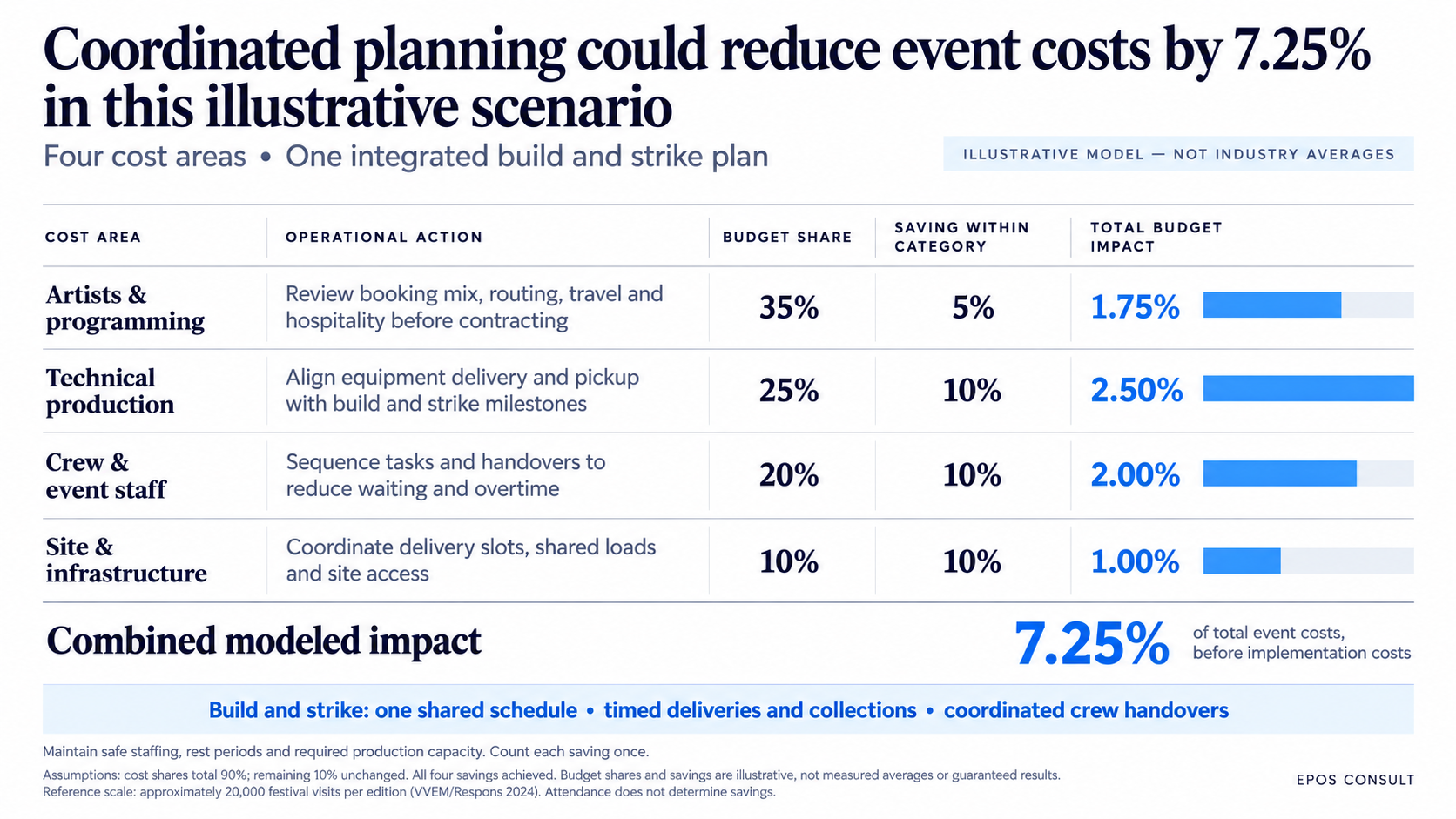
Review booking mix, routing, travel and hospitality before contracting.
35% budget share × 5% category saving = 1.75% total budget saving.Align equipment delivery and pickup with build and strike milestones. Remove duplicate equipment and idle rental days.
25% budget share × 10% category saving = 2.50% total budget saving.Use one build and strike schedule. Sequence tasks and handovers to reduce waiting and overtime, maintaining safe staffing and rest periods.
20% budget share × 10% category saving = 2.00% total budget saving.Coordinate timed deliveries and collections, shared loads and site access to avoid blocked access, repeat trips and delays.
10% budget share × 10% category saving = 1.00% total budget saving.Combined modeled impact: 7.25% of total event costs before implementation costs. Assumes all four reductions are achieved. These categories cover 90% of the example budget; the remaining 10% is unchanged. Assign each cost and saving once. Build and strike efficiencies are included, not added separately.
Reference scale: approximately 20,000 festival visits per edition, derived from 24.7 million visits across 1,225 festivals in the 2024 VVEM/Respons figures. Visits are not unique attendees. This reference scale does not determine budget shares or savings. View the attendance source.
Download the budget visual (PNG) ↓Where EPOS can help
The scope and deliverables are tailored to your organization, event cycle, and priorities.
Map the planning-to-delivery process, identify bottlenecks and clarify where ownership or information breaks down.
Output: a prioritized improvement roadmap with owners and next steps.
Review cost drivers, supplier commitments, resource planning and budget changes to expose avoidable waste and strengthen spending decisions.
Output: a cost baseline, opportunity list and budget review routine.
Define a focused set of operational measures with clear owners, reliable inputs and agreed escalation points.
Output: a practical KPI dashboard and a regular schedule for decisions and follow-up.
Connect internal teams, freelancers and suppliers through clearer briefs, responsibilities, handovers and change control.
Output: process maps, responsibility agreements and handover checklists.
Adapt the operating model as your organization grows or changes. Turn improvement plans into routines your team can maintain.
Output: an implementation plan, management routines and team coaching.
Add senior operational capacity during a transition, improvement program or leadership gap, with scope and authority clearly agreed.
Output: accountable day-to-day leadership and a structured handover.
AI Solutions
EPOS Consult can facilitate AI solutions and guide implementation around your most significant operational cost drivers. Start with the business problem, connect the right information and turn approved decisions into accountable action.
Bring budgets, supplier commitments and production schedules together to assess how a change could affect crew hours, equipment rental and transportation.
Implementation guidance: establish the cost baseline, agree calculation rules and work with your technology partner to pilot a source-linked change review and approval process.
Support checks between quotes, agreed orders and invoices to flag duplicate items, rate differences or additional rental days for human review.
Implementation guidance: map purchasing records, define exceptions, test against known cases and assign ownership for supplier queries and confirmed corrections.
Use AI-assisted analysis and tested calculations to explore crew calls, equipment windows and delivery schedules within agreed operational constraints.
Implementation guidance: document skills, availability and delivery requirements; coordinate scenario testing with planners and technical specialists before operational use.
Prepare management briefings that connect cost deviations and delivery issues to supporting evidence, decisions, owners and due dates.
Implementation guidance: select meaningful KPIs, set escalation thresholds, establish approval roles and coach managers in a regular review routine.
Help teams find relevant supplier agreements, production procedures and previous evaluations, with answers linked to approved source material.
Implementation guidance: organize the knowledge base, assign document owners, test access and answer quality, and train teams to review and maintain the content.
Bring available usage data and production requirements together to highlight equipment or power provision that deserves a closer technical review.
Implementation guidance: agree data requirements and a measurement baseline with qualified suppliers, test recommendations and verify costs after approved changes.
These are potential applications to scope and validate with your organization. Required integrations and calculations are assessed with suitable technology specialists. Your authorized team retains operational and spending decisions.
AI implementation guidance
Prioritize cost opportunities, check data readiness and define the business case. Agree the process owner, technology requirements and success measures before selecting a solution.
Coordinate your team and technology specialists around a bounded pilot. Test source accuracy, calculations, permissions and approval steps against representative operational cases.
Train users, clarify responsibilities and support rollout. Review adoption and verified outcomes, separating cash savings from time released and deducting implementation and running costs.
The cost scenarios above illustrate operational opportunities; they are not measured AI results. Savings depend on your baseline, contracts, implementation and actual use.
Discuss your AI opportunitiesYour consultant / Eg Poster
DJ since 1990. Qualified in sound engineering and music production. An experienced operations leader bringing practical business discipline to live entertainment.
Eg Poster, founder of EPOS Consult, combines 20+ years of international management and transformation experience with a longstanding practical background in music. He has been active as a DJ in clubs in the Netherlands and internationally since 1990, developing a feel for audiences, atmosphere, music selection and live-event environments.
His Pro Sound Engineer & Music Producer diploma from Sound Education Nederland (2024) and SMIA Music Industry certificate add technical production knowledge and an understanding of the sector’s structure and commercial context.
Eg is now bringing these two parts of his experience together: helping music and event organizations strengthen planning, cost control and execution while protecting production quality and the audience experience.
Club experience in the Netherlands and internationally, with a practical understanding of music, audiences and live environments.
Pro Sound Engineer & Music Producer diploma, Sound Education Nederland, 2024.
A certificate covering the music industry’s structure and commercial context, alongside regular festival attendance and annual participation in events around Amsterdam Dance Event (ADE).
Experience relevant to event delivery
The following experience comes from industrial and healthcare assignments. It provides transferable operational expertise for event organizations; these are not music-industry consultancy projects.
At Azule Energy, Eg led an improvement program across two offshore production vessels and onshore teams. His work connected planning, materials, capacity and execution.
Relevance to events: align production milestones, supplier readiness and resources before teams arrive on site.
As Interim Head of Retail at Unilabs, Eg held operational responsibility for a network of 300+ blood collection locations and 400+ FTE.
Relevance to events: establish clear responsibilities, consistent working practices and escalation routes across teams and locations.
As Interim Operations Manager at ECT Rotterdam, Eg delivered €7M+ EBIT improvement through resource planning, cost control and execution discipline.
Relevance to events: make commitments and resource needs visible, challenge avoidable costs and follow through on agreed improvements.
Practical leadership, supported by formal training. MBA, Business School Nederland (2015); Leading Change, Rotterdam School of Management, Erasmus University (2025). Eg works in Dutch, English and German.
Discuss how this experience could support your organization →A focused engagement
Discuss your organization, upcoming priorities and operational pressures. Agree what success should look like.
Review the relevant processes and information. Choose the improvements that deserve attention first.
Work with your team on clear actions, owners and measures, then establish routines to sustain progress.
A practical first step
Tell Eg where costs, coordination or growth are putting pressure on your organization. Start with a focused conversation about what needs to change.
Contact Eg Poster